
Beyond water · WECP
One measurement. Four records.
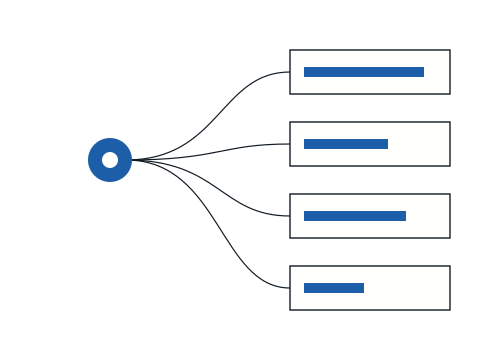
Water, Energy, Carbon, Productivity. Veracity's infrastructure verifies all four from a single measurement and keeps each in its own record.
02In short
What WECP means.
Water, Energy, Carbon and Productivity: the four impacts Veracity's infrastructure verifies from one measurement, each kept in its own record and its own unit.
- 01Linked impacts, assessed together.
- 02One measurement, four records.
- 03No single score that hides a trade-off.
03The problem
Silos that contradict each other.
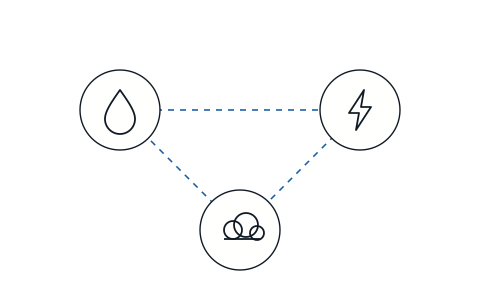
A project optimised for one criterion can degrade another.
- Saving water with wet cooling can raise energy use and CO₂ emissions.
- Low-carbon energy such as hydropower or biofuels can increase water use.
- Pumping, treating and distributing water uses energy: each m³ saved can avoid part of it.
04Why one score fails
An aggregate figure hides trade-offs.
A single score is tempting, but it mixes different goods.
- It adds up incompatible units: m³, MWh and tCO₂e.
- It lets a strong result offset a weak one.
- It does not say which dimension needs fixing.
- Instead: the weakest dimension sets the combined level.

05Four modules
Each impact in its own unit.
Each impact has its own normative module, versioned independently of the others.
 WaterVolumes saved, reused or restored.
 EnergyEnergy avoided across pumping, treatment and processes, traced apart from carbon.
 CarbonEmissions avoided, with additionality and permanence.
 ProductivityOperational gain per unit of resource.
06How it works
One measurement, four records.
The same project, measured once, produces four verified records.
- 01Dynamic baselineBaseline data is collected continuously.
- 02Calculate each impactEach module calculates its impact in its own unit.
- 03VerifyAn independent verifier. Checks each result.
- 04RecordEach certified performance is recorded separately in a registry.

07What it brings
Decisions that hold on every criterion.
For the project holder and the buyer alike, the gain lies in seeing the trade-offs.
- Project holders: see the trade-offs before choosing a solution.
- Utilities and industry: steer water and energy from one measurement.
- Buyers: one readable record per good, never a misleading sum.
- Public authorities: water, energy and climate policies that reinforce each other.
08Reference frameworks
An approach institutions are taking up.
The nexus is gaining ground: the European Commission makes it a strand of its water resilience strategy. Veracity makes it operational.
- One calculation, four records.
- Impacts assessed together, never added up.
- Compatible with CSRD, CDP Water, GRI 303 and SBTN, without claiming equivalence.

+Questions
Why four records instead of one score?
Because water, energy, carbon and productivity are different goods. They are never added together.
Can a carbon result make up for a weak water result?
No. A strong carbon result can never hide a weak water result.
What happens when a combined level is needed?
The weakest dimension sets it.
Does each impact need its own measurement?
No. Veracity's infrastructure verifies all four from a single measurement, then keeps each in its own record.
In which units are impacts recorded?
Water in m³, energy in MWh avoided, carbon in tCO₂e avoided, productivity as operational gain per unit of resource.
What is the main certified impact?
Water. The other data can be included as metadata on the certificate (bundled) or certified separately (unbundled).