
Protocol AWH
Q3 2027Water drawn from the air.
Water drawn from the air, really supplied and of drinking quality, becomes an asset you can put to work.Water drawn from the air, really supplied, becomes an asset you can put to work.
02The situation
Water where networks do not reach.
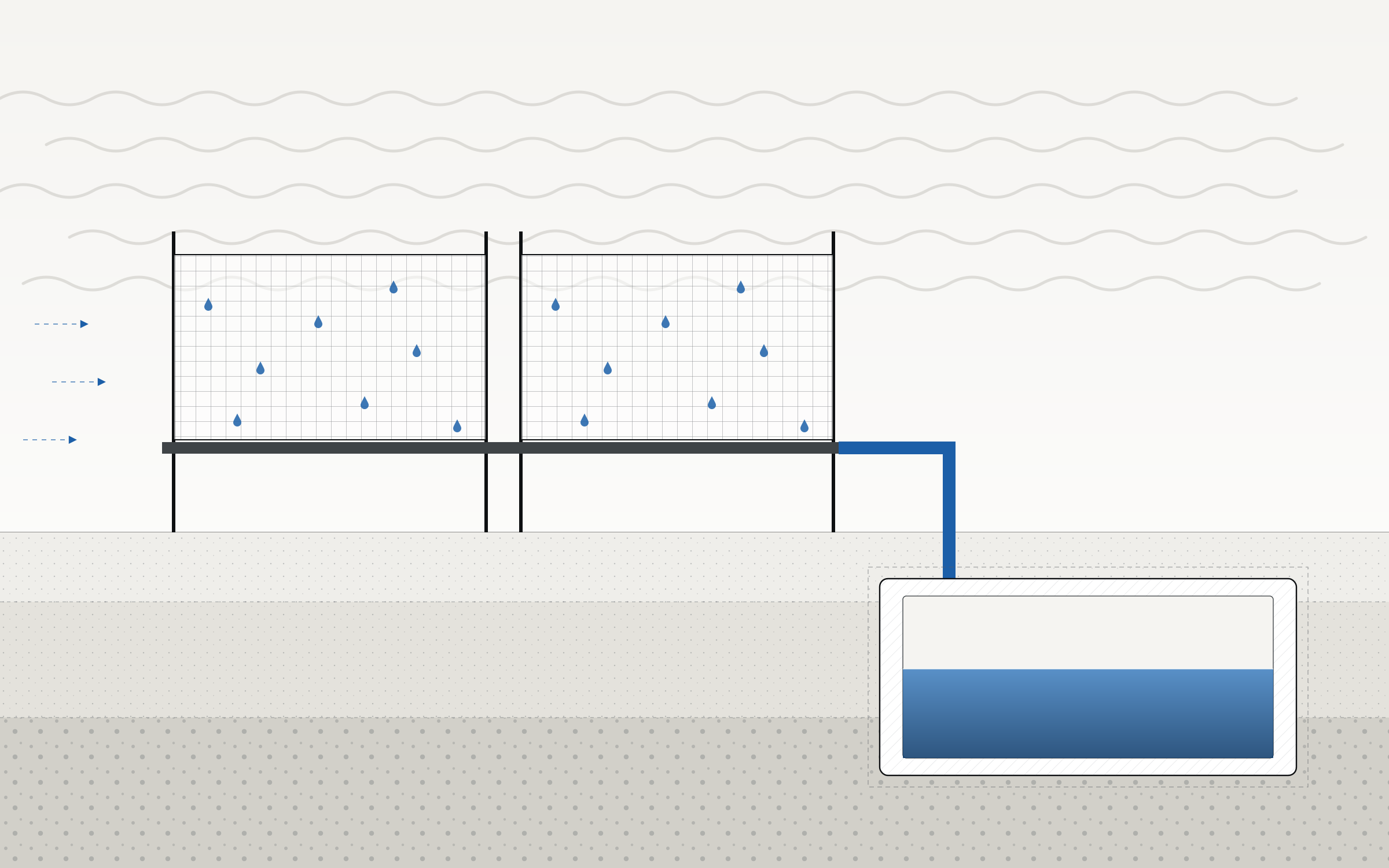
Fog nets and air-to-water generators can supply drinking water where there is no network. But output follows the humidity of the air, and the energy per litre varies widely.Output follows the air; energy per litre varies widely.
03Who it is for
What each party gains.
One output, certified once, serves every party: project developers, technology providers, local authorities and the companies committed in the basin.One output, certified once, serves every party.
- Project developersProve the litres really supplied, to value and finance the installation.
- Technology providersFog nets, generators, sorbents: get paid per verified litre, not per announced capacity.
- Local authorities and communitiesReplace tanker trucks or bottles with a measured, traceable local supply.
- Contributing companiesA traceable contribution in your basin, reusable in your water reporting.
04Methodological alignment
Credible by design.
Built on the references auditors, regulators and funders already use. Nothing that matters is self-declared.
- Water accounting
- VWBA 2.0
- ISO 14046
- Measurement & verification
- IPMVP
- ISO 14064-2
- ISO 14064-3
- Evidence & traceability
- ISO 22095
- ISO/IEC 15459
- Independent verification
- ISO/IEC 17029
- ISO 14065
Data reusable in:CSRD · ESRS E3 · CDP Water Security · SBTN Freshwater · AWS Standard v3.0 · GRI 303 · CEO Water Mandate
05What we certify
Litres really supplied.
We certify the drinking water really supplied, not the capacity announced. Quality and energy per litre are associated indicators; energy is shown as a charge when it weighs.The water supplied, with its quality and its energy.
- Water supplied (WRC). The litres drawn from the air and supplied to a real use.
- Drinking quality. Tested against the standard of the use, an associated indicator.
- Energy per litre. Measured and shown, as a charge when it is net.

06How it works
From air to certificate.
Each step leaves evidence the independent verifier can check.Each step leaves verifiable evidence.
 01QualifyNo network or an unsafe one, a real use, humidity measured on site.
 02Set the baselineThe supply the water replaces: tanker, bottles or borehole.
 03Meter the water suppliedLitres metered at the point of use, month after month.
 04Test the qualityDrinking quality tested at regular intervals.
 05Verify and certifyAI agents on every data point, validation by an accredited verifier, issuance on the registry.
07The measurement
The litres supplied, not the capacity.
A machine's announced capacity is reached only in humid air. The protocol counts the litres really supplied, month after month, with the energy used to produce them. The detailed calculation and verification method is being developed with the protocol.Only the litres really supplied count.
- Litres metered, never the nameplate capacity.
- Energy per litre measured and shown.
- Detailed method being developed with the protocol.

08Get started
Producing water from the air? Make your action count with us.
Start with one site, prove it, then scale up.Start with one site: prove it, then scale.
+Questions
What is verified?
The litres really supplied, their drinking quality and the energy used per litre.
Is the energy cost counted?
Yes. Energy and carbon are measured and shown with the water; when they weigh, they are shown as a charge, never as a benefit.
Why not the capacity of the machine?
Because output follows the humidity of the air. Only the litres metered at the point of use count.
Where is it relevant?
Where networks do not reach or are unsafe, and where the air is humid enough: coasts, foggy uplands, islands.
When will the protocol be active?
The target date for this protocol is Q3 2027. We are looking for project developers and technology providers to design the protocol methodology on a founding pilot.