
Protocol WRC-RWH
Q1 2027Rain used, network water saved.
The protocol for rainwater captured and used on site. Only water actually used in place of network or groundwater counts.Each cubic metre of rain used in place of network water becomes a verified certificate.
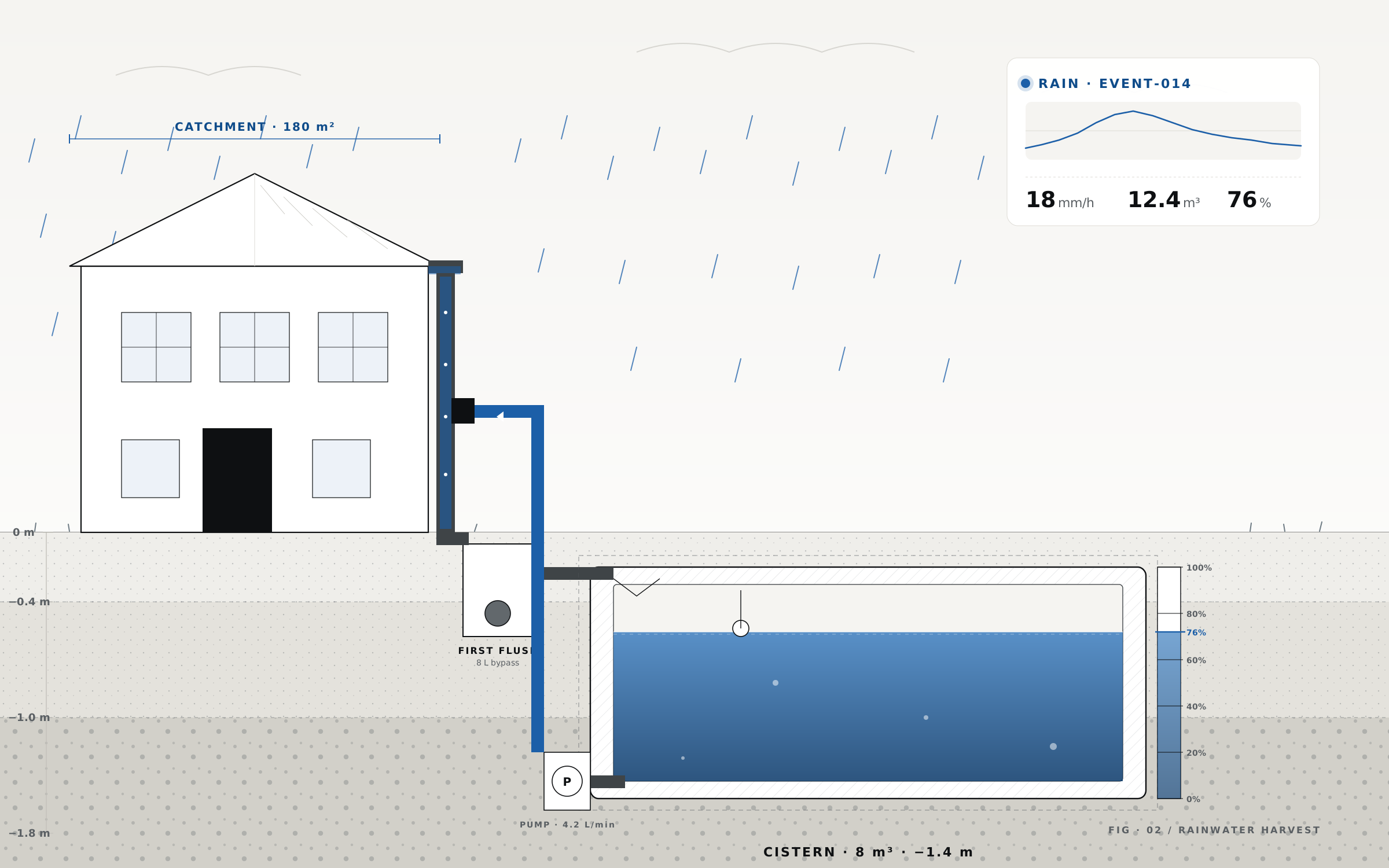
02The situation
Rain falls on basins under strain.
Every year, close to a third of Europe runs short of water for part of the year. Yet drinking water still serves uses that do not need it: rain can take its place.About 30% of EU land runs short of water every year.
03Who it is for
What each party gains.
One installation, certified once, serves every party: building and site owners, solution providers, local authorities and the companies committed in the basin.One installation, certified once, serves every party.
- Buildings, campuses and industrial sitesDraw less from the network, hold up better during restrictions, and prove it.
- Solution providersTanks, treatment, sensors: get paid per cubic metre of rain used and verified.
- Local authoritiesRelieve the drinking water and stormwater networks, and record the volumes on the registry.
- Contributing companiesA traceable contribution in your basin, reusable in your water reporting.
04Methodological alignment
Credible by design.
Built on the references auditors, regulators and funders already use. Nothing that matters is self-declared.
- Water accounting
- VWBA 2.0
- ISO 14046
- Measurement & verification
- IPMVP
- ISO 14064-2
- ISO 14064-3
- Evidence & traceability
- ISO 22095
- ISO/IEC 15459
- Independent verification
- ISO/IEC 17029
- ISO 14065
Data reusable in:CSRD · ESRS E3 · CDP Water Security · SBTN Freshwater · AWS Standard v3.0 · GRI 303 · CEO Water Mandate
05What we certify
One roof, two distinct volumes.
One balance, verified once, separates the rain used from the rain returned to the basin. Each cubic metre is counted once. Energy and carbon are shown alongside, including any increase.One balance, two volumes, each cubic metre counted once.
- Substitution (WRC). Rain used in place of network or groundwater.
- Basin (WRC). Rain infiltrated towards the aquifer, or peak runoff held back.
- Energy and carbon. An attribute shown with the certificate, never a certificate in itself.

06How it works
From rain to certificate.
Each step leaves evidence the independent verifier can check.Each step leaves verifiable evidence.
 01QualifyBasin under strain, a real non-potable use, additionality shown for each volume.
 02Prove the baselineThe network or aquifer withdrawal replaced, proven by bills or meter records.
 03Measure the balanceRain gauge, tank level probe and use meter, over at least one full hydrological year.
 04Assign each m³Use or infiltration: one destination per cubic metre; overflow does not count.
 05Verify and certifyAI agents on every data point, validation by an accredited verifier, issuance on the registry.
07The measurement
Counting each cubic metre once.
The protocol draws up the balance from roof to use over at least one year: rain collected, water used, water infiltrated, overflow. Only water actually used or infiltrated counts; overflow sent to the sewer is never certified.Only water used or infiltrated counts, never the overflow.
- Balance over at least one full year, taken at the lower value.
- Supply reliability accounted for: overflow and empty tank.
- A lightly equipped small installation gets a more cautious volume, not a refusal.

+Questions
Does all collected rain count?
No. Only rain actually used in place of network or groundwater counts.
Which sites qualify?
Buildings, campuses and industrial sites that cover part of their non-potable use with rain.
Why normalise for rainfall?
So results reflect how well the system is run and maintained, not how much it rained that year.
Can it be sold as a service?
Yes. The protocol supports pay-per-use or subscription models, verified for both sides.
What does “Q1 2027” mean?
It is the target date for this protocol. Until then, it is being finalised with founding pilots.